Journal · Wine · May 15, 2026 · 6 min read
Willamette A Loire chef's guide to the Willamette Valley
Same grape, two grounds. Five varietals, four wineries, and the Loire–Willamette comparison I pour at every private dinner.
There is a road outside Bourgueil that runs along the south bank of the Loire for about twenty minutes before the vineyards begin. My brother drove me along it the summer I turned eight. I remember three things. The cigarette he was smoking with one hand on the wheel. The smell of the river. And the fact that he kept saying, almost to himself, the same word: limon. Silt.
I think about that road every time I drive Route 99W out of Portland on a Saturday morning. The light is different. The river is different. The way the soil changes as you climb out of the valley floor is the same. So is the silt.
I came to Portland expecting a copy of something I knew. I found something else.
A note before we begin.
My family makes wine in the Loire. I trained for eight years in a Michelin-starred kitchen in France. I have been a private chef in Portland since 2018. The wines I pour at my clients' tables are mostly Loire wines and mostly Willamette wines, set next to each other on the same table with the same food. That is the only reason I am qualified to write any of this.
Same grape, two grounds.
This is the comparison I run at almost every private dinner. The Loire bottle and the Willamette bottle of the same varietal, opened at the same time, served with the same course. The Loire side is my brother's network. The Willamette side is wines I have known long enough to trust.
| Grape | Loire pour | Willamette pour |
|---|---|---|
| Chenin Blanc | Domaine Huet Le Mont sec, Vouvray | Brick House Chenin Blanc, Ribbon Ridge |
| Sauvignon Blanc | Edmond Vatan Sancerre | Trisaetum Sauvignon Blanc |
| Pinot Noir | Sancerre rouge, Vacheron or Pinson | Walter Scott La Combe Verte, Eola-Amity |
| Cabernet Franc | Bernard Baudry Les Granges, Chinon | Walter Scott Cabernet Franc |
| Gamay | Domaine Sérol Côte Roannaise | Division Wine Co. Lutte Gamay |
The Chenin pairing is the one that surprises the table. People do not expect Oregon to be making serious Chenin, and the Brick House bottle, when it is in form, reads like a young Vouvray that has lost interest in being a young Vouvray and would prefer to be a salt-laced grown-up. I open it ahead of any meal that involves butter.
The Cabernet Franc is where the table goes quiet. There is something in green Loire Cab Franc that Americans rarely encounter. The Walter Scott bottle is more polished but reaches for the same note. If you have ever been served a Chinon with a duck confit and been a little confused about whether you liked it, the Walter Scott will make the confusion useful.
The Sauvignon Blanc is the one I am still arguing with myself about. Sancerre is a sharp knife. Most Oregon Sauvignon Blanc tastes like a wider, slower wine. The Loire wins, more nights than not. I keep pouring it because losing is sometimes the lesson.
The wineries I send people to.
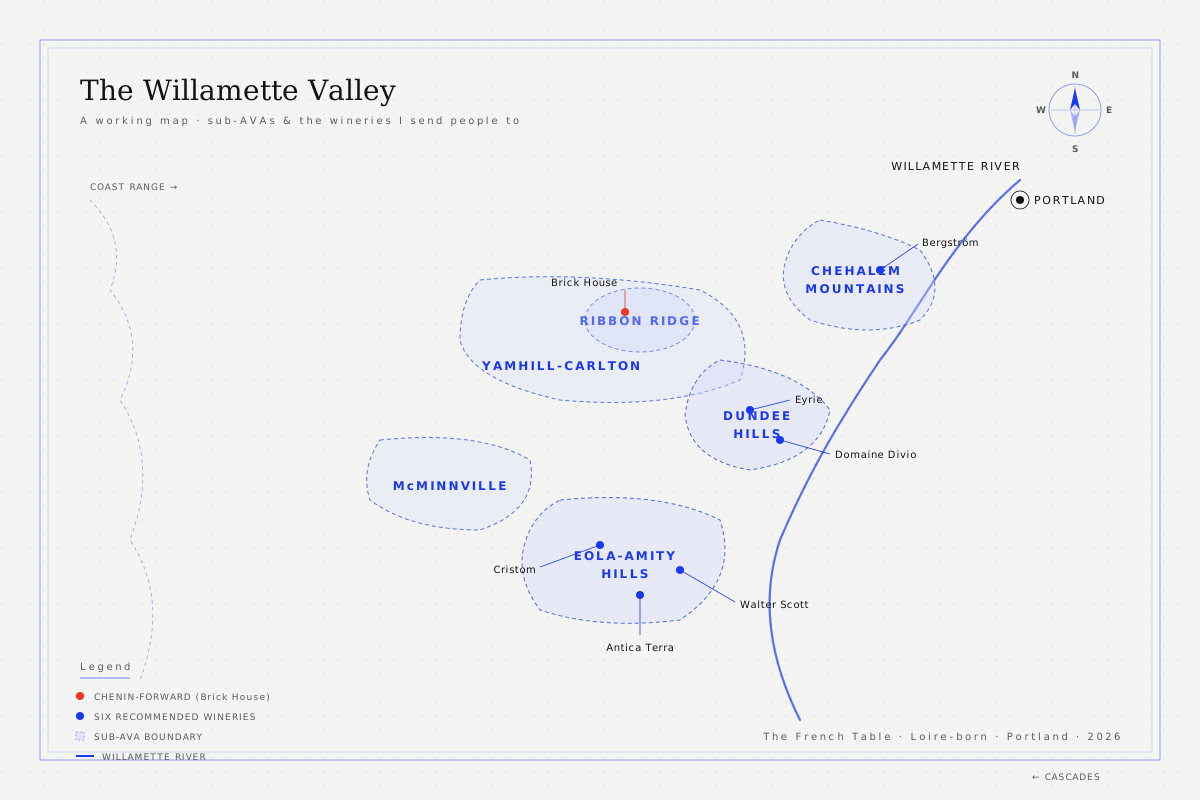
Not the best wineries in the Willamette. The four places I would send a guest who asked me where to go. I trust the bottle, I trust the room, and I have eaten at least one good meal nearby.
Brick House Vineyards · Ribbon Ridge. Doug Tunnell has been farming biodynamically since the 1990s. The Chenin Blanc is the bottle that got me writing this. The Pinot is excellent, the Chenin is rare. Call ahead.
Walter Scott · Eola-Amity Hills. Ken Pahlow and Erica Landon. The Cab Franc I poured against Bernard Baudry in February of 2024 made the table get quiet. The Chardonnay program is also serious.
Cristom Vineyards · Eola-Amity Hills. Old-school producer, deep library, single-block Pinots that age. The terroir-by-block lineup is the easiest way to taste why Eola-Amity is different from the rest of the valley in a single sitting.
Eyrie Vineyards · Dundee Hills. Founded by David Lett in 1965, the producer that started Oregon Pinot. Jason Lett runs it now. The original site. Worth the visit on principle.
A peer worth a mention. Domaine Divio · Dundee Hills. Bruno Corneaux trained in Burgundy and has been making Pinot in Oregon since 2013. He is a friend and we have co-hosted Loire trips together. Schedule it if you are doing Dundee Hills.
How to taste like a chef.
Eat before you taste
Most tasting rooms open at eleven. Most guests show up hungry, get poured five wines on an empty stomach, and rate everything kindly. The third wine you taste will thank you.
Ask what the winemaker hates
Every winemaker hates something about every vintage. The answer tells you more than ten minutes of tasting notes. A winemaker who will admit any of this is a winemaker whose bottles I buy.
Buy one to lay down
Almost every serious Willamette Pinot improves between three and seven years from harvest. The bottle you open in three years is the bottle that will teach you the place.
Before you go.
How much should I budget per person?
Drive or hire a driver?
Can you set up the tastings for me?
Do your pairings use only French wine?
Is the Willamette better than Burgundy?
One last image.
The last bottle I poured that made me stop talking was a 2018 Brick House Chenin Blanc. We had just sat down to a salt cod cake and a brown-butter sauce. The cork was perfect. The pour was the color of dried straw. I held the glass and thought, for a moment, that I was eight years old again, on the back of my brother's car, looking at silt.
That is the only reason any of this is interesting. Not that the Willamette is the Loire, or that it is not. Just that, sometimes, a wine can do the thing wines are supposed to do. It can move you across an ocean.
The next time you drive to the Willamette, take the long way. Stop at the side of the road, get out of the car, and walk into the dirt. Look at what you are standing on. That is most of the work.
À bientôt.
Antonin
The French Table · Portland, Oregon